



You're three days from launch. The bug count's climbing. Marketing wants to know who signed off on the messaging. Two engineers and a PM all think they own the go/no-go call. Somewhere in a Confluence doc nobody opened, there's a RACI chart that was supposed to prevent exactly this.
The chart isn't the problem. The framework is.
RACI is the default everyone reaches for, but it's not the only option, and it's not always the right one. RASCI, DACI, and RAPID didn't get invented for fun. Each fixes a specific way RACI breaks down. Pick the wrong one and you end up in the launch meeting we just described.
Why These Four Frameworks Aren't Interchangeable
RACI manages tasks. DACI and RAPID manage decisions. RASCI is RACI with one extra role.
The biggest mistake teams make is treating these like four flavors of the same thing. They're not. RACI and RASCI cover task ownership: who does the work, who signs off, who stays in the loop. DACI and RAPID cover decision ownership: who recommends, who decides, who has veto power.
That distinction sounds small. It isn't. A team using RACI to make a decision will deadlock every time, because RACI doesn't have a "decider." It has an Accountable, which is closer to "owns the outcome" than "makes the call." And a team using DACI to track day-to-day execution will frustrate everyone, because DACI assumes you're driving toward a single decision, not running a project with a dozen moving parts.
Pick the framework that matches the work, not the one your last manager used.
What Is RACI?
RACI assigns one of four roles to every stakeholder on a task: Responsible, Accountable, Consulted, Informed.
RACI is the OG of responsibility frameworks. Most teams default to it the same way they default to RICE for prioritization.
- Responsible is the person doing the work.
- Accountable is the single person who owns the outcome and signs off.
- Consulted are the experts whose input you need before the work happens.
- Informed are the people who need to know after the fact.
It works best for project execution with clear deliverables and finite endpoints. Where it falls apart is anything that looks like a decision rather than a task. RACI also tends to bloat. The most common failure is filling out the chart for tasks that don't need one, then watching it get ignored because nobody trusts it anymore.
When Should You Use RASCI Instead of RACI?
Use RASCI when someone is doing real work on a task but isn't the owner, and you don't want to call them Consulted because they're doing more than offering input.
RASCI is RACI with one extra letter: S for Support. The Support role exists because Consulted gets misused. A junior PM helping a senior one execute isn't really a consultant. They're hands-on. Lumping them into Consulted understates their contribution and confuses ownership.
That's the only difference. Same four core roles, plus an explicit "they're helping but not driving" seat at the table. RASCI works well in matrixed orgs where contributors flow across teams. The failure mode is using it when you don't need it: if no one on the project fits the Support role naturally, you're adding a column for the sake of it. Stick with RACI.
What Is DACI?
DACI assigns four roles for making a decision rather than executing a task: Driver, Approver, Contributor, Informed.
DACI was popularized by Atlassian and lives in product orgs that needed something faster than RACI for decision-heavy work.
- Driver owns moving the decision forward, gathering input and pushing toward a call.
- Approver has final say.
- Contributors offer expertise.
- Informed find out the outcome.
The split nobody catches at first: Driver is not the same as Approver. Driver runs the process. Approver makes the call. That separation is what gives DACI its speed. The most common failure mode is collapsing the two roles into one person, which turns DACI into a slow single-Approver bottleneck. Use it for cross-functional decisions where one person needs final authority but the work to inform it is shared.
What Is RAPID?
RAPID assigns five roles to high-stakes decisions: Recommend, Agree, Perform, Input, Decide.
RAPID came out of Bain & Company and is built for decisions that involve serious money, risk, or political weight.
- Recommend is the person developing the proposal.
- Agree has veto power on parts of the decision (often legal, compliance, or another function with hard requirements).
- Perform executes the decision once made.
- Input offers expertise without veto.
- Decide is the final authority.
The veto role is what separates RAPID from DACI. If your decision has stakeholders who can hard-block it (legal, security, finance), RAPID is built to handle that. The failure mode is using RAPID for decisions that don't have real veto holders. The framework adds overhead, and you end up with a five-letter chart for a two-person call.
Which Framework Should You Use?
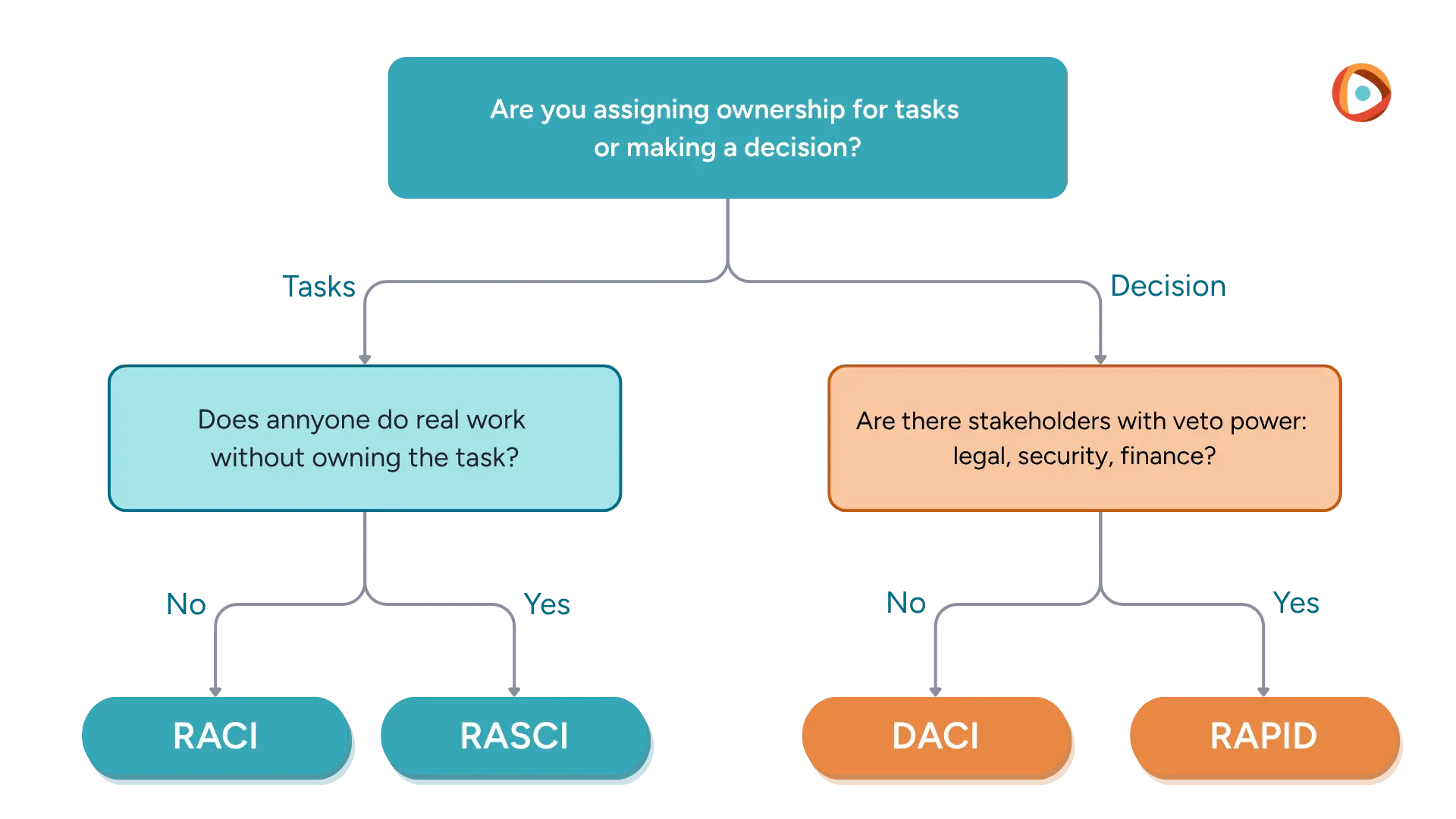
Two questions get you the right answer: are you running tasks or making a decision, and how messy does it get from there.
Start with the first question. If you're assigning ownership for work that has clear deliverables and a finite endpoint, you're in task territory. Default to RACI. If your team has people who genuinely contribute without owning (junior PMs, rotating contributors, cross-team helpers), upgrade to RASCI. If nobody fits that role naturally, RACI is fine and adding letters won't help.
If you're making a decision instead of executing one, switch to DACI or RAPID. Use DACI for most cross-functional calls: a small group of contributors, one Approver, one Driver to keep things moving. Save RAPID for when the decision has real veto power baked in (legal, security, finance, or another function that can hard-stop the work). RAPID adds overhead, and that overhead is only worth it when the stakes justify it.
The shortcut: tasks default to RACI. Decisions default to DACI. RAPID is for the high-stakes calls where a wrong decision is genuinely dangerous.
When to break your own rule
Don't fill out a chart for tasks a five-minute Slack message resolves. Don't add a Support role nobody actually fits. Don't use DACI when your "Driver" doesn't have time to drive. The framework is a tool, not a deliverable. If you're building one for the chart's sake, scrap it.
What This Looks Like in a Real Product Launch
A real launch isn't one chart. It's three different frameworks across four phases, depending on whether you're running tasks or making calls.
Take a cross-functional product launch from beta program through GA. Here's how the right framework shifts by phase.
Phase 1: Beta recruitment and test plan (RACI)
The beta manager runs candidate recruitment. The PM owns the test plan. Marketing handles the recruit-facing comms. Engineering is Informed, not on the hook for execution. Clear deliverables, finite endpoint, defined sign-offs. RACI was built for exactly this.
Phase 2: Mid-beta "extend or ship?" call (DACI)
This isn't a task, it's a decision: do you extend the beta to gather more data, or ship on schedule with what you have? PM is Driver, gathering bug counts and beta feedback. VP Product is Approver. Beta manager and eng lead are Contributors. Marketing and Support are Informed. RACI would deadlock here because nobody owns the decision itself, only the work feeding into it.
Phase 3: GA launch readiness checklist (RACI)
Back to tasks. Eng owns final QA. Support owns docs and CS readiness. Marketing owns launch comms. PM is Accountable across the board. Every checklist item has a clear owner, a clear sign-off, and a readiness metric tied to it. RACI does this better than anything else.
Phase 4: "Delay launch over a critical bug?" call (RAPID)
Eng lead Recommends. Legal and security can Agree (read: veto). PM and Support provide Input. The Decide role lives with VP Product or higher depending on stakes. RAPID is built for exactly this kind of call, where one stakeholder saying "no" actually counts.
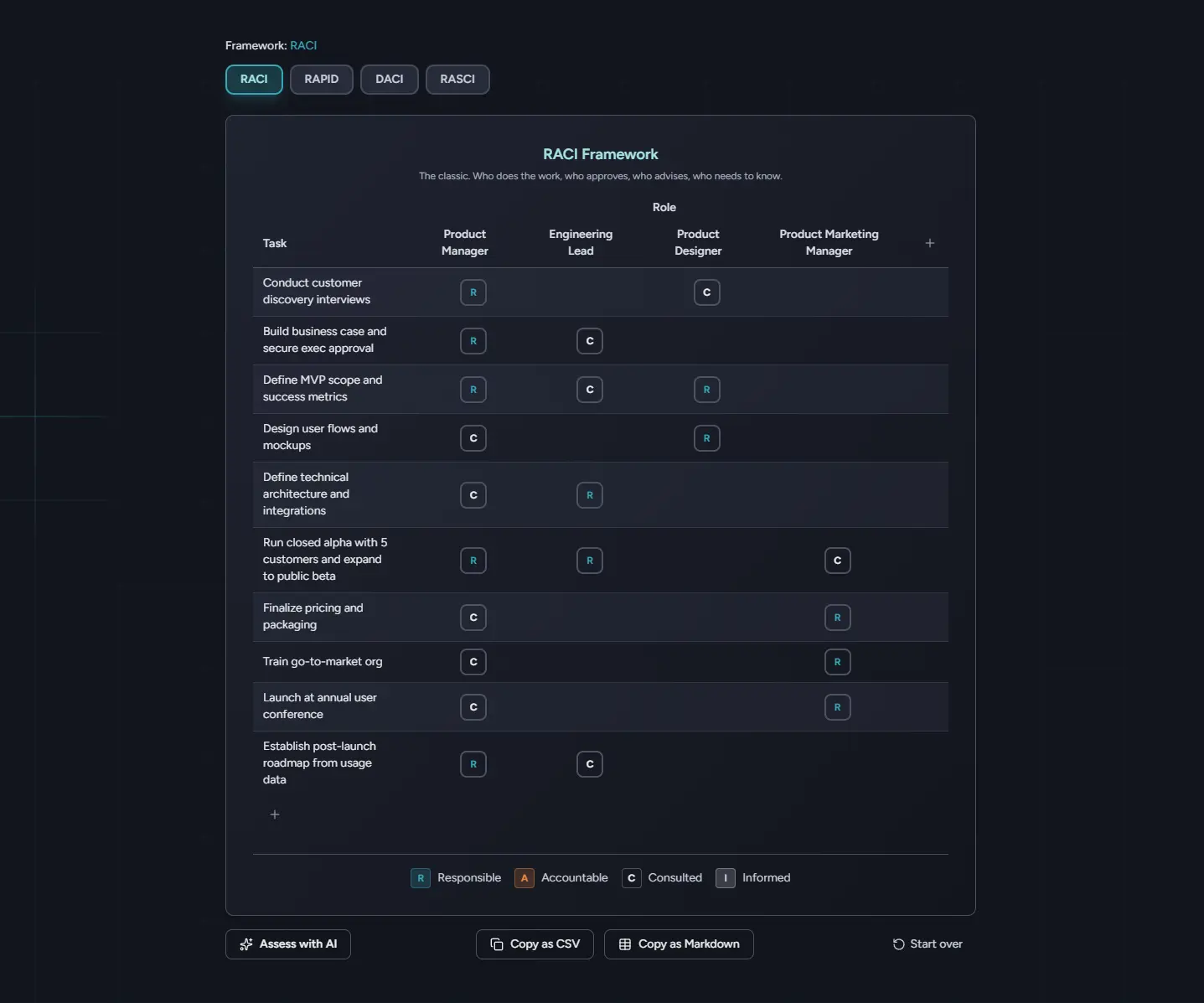
One launch, three frameworks, four phases. If you're switching between them on a spreadsheet, you'll lose half a day rebuilding charts and you still won't know if you missed an Accountable somewhere. RACI Reactor on Centercode Labs handles all four and runs an AI review to flag the gaps. Swap structures per phase without starting from scratch.
What About ARCI, PARIS, PACSI, MOCHA, and the Rest?
ARCI is just RACI rearranged. The rest are real frameworks tuned for niches outside tech and product work.
You'll see other variants in the wild. ARCI is RACI with the letters reordered, same four roles, different emphasis. The others are real frameworks built for specific contexts: PARIS for construction and contract-heavy projects, PACSI for regulated industries like pharma and finance, MOCHA for nonprofit operations.
None of them are wrong, just niche. If you're running a product launch, a software project, or a cross-functional initiative inside a tech-adjacent org, the four above are the ones that'll actually get adopted and used. Pick from RACI, RASCI, DACI, or RAPID and you're rarely the person who picked wrong.
Pick Your Framework, Then Skip the Spreadsheet
Picking is the hard part. Building the matrix shouldn't be. Catching the gaps in your matrix definitely shouldn't be.
You picked a framework. Or narrowed it to two and you'll pick once you start drafting. Either way, the framework is the easy part. The slow part is building the matrix. The risky part is the gaps you don't notice: missing accountables, duplicate drivers, tasks no one owns.
RACI Reactor handles all four. Describe your project and AI builds the matrix, or build it yourself. Run an AI review to catch the gaps that bite teams six weeks in. Free.
Then go run the launch the chart was supposed to help with.
Frequently Asked Questions
What's the main difference between RACI and DACI?
RACI assigns ownership for tasks (who does the work, who signs off). DACI assigns ownership for decisions (who recommends, who decides). If you're executing, use RACI. If you're choosing between options, use DACI.
Is RAPID better than RACI?
No. They solve different problems. RAPID handles high-stakes decisions with multiple stakeholders who can veto (legal, security, finance). RACI handles task execution with clear deliverables. Use RAPID when stakes are high and DACI's single-Approver model isn't enough.
When should I use RASCI instead of RACI?
Use RASCI when someone on the project is doing real work without being the owner, and Consulted understates their contribution. Common in matrixed orgs with rotating contributors. If nobody fits the Support role naturally, stick with RACI.
What does the "A" mean in RACI?
"A" stands for Accountable: the single person who owns the outcome and signs off. There should be exactly one Accountable per task. Multiple A's create ambiguity, no A creates orphan tasks.
Can you use multiple frameworks on the same project?
Yes, and most cross-functional projects need to. Use RACI for task execution and DACI or RAPID at decision points. A product launch typically uses RACI for recruitment and readiness phases and DACI or RAPID for "ship or extend?" and "delay over critical bug?" calls.


